Will it make my ride worse?
No. The gel liner does not stiffen the tire, alter its sidewall flex, or change the contact patch. If anything, the foam layer absorbs small vibrations that a bare tire transmits directly into the wheel.
The concern makes sense. A tire is a precisely engineered pressure vessel, and adding material inside it sounds like it should change something. The key detail is where the liner sits and what it is made of.
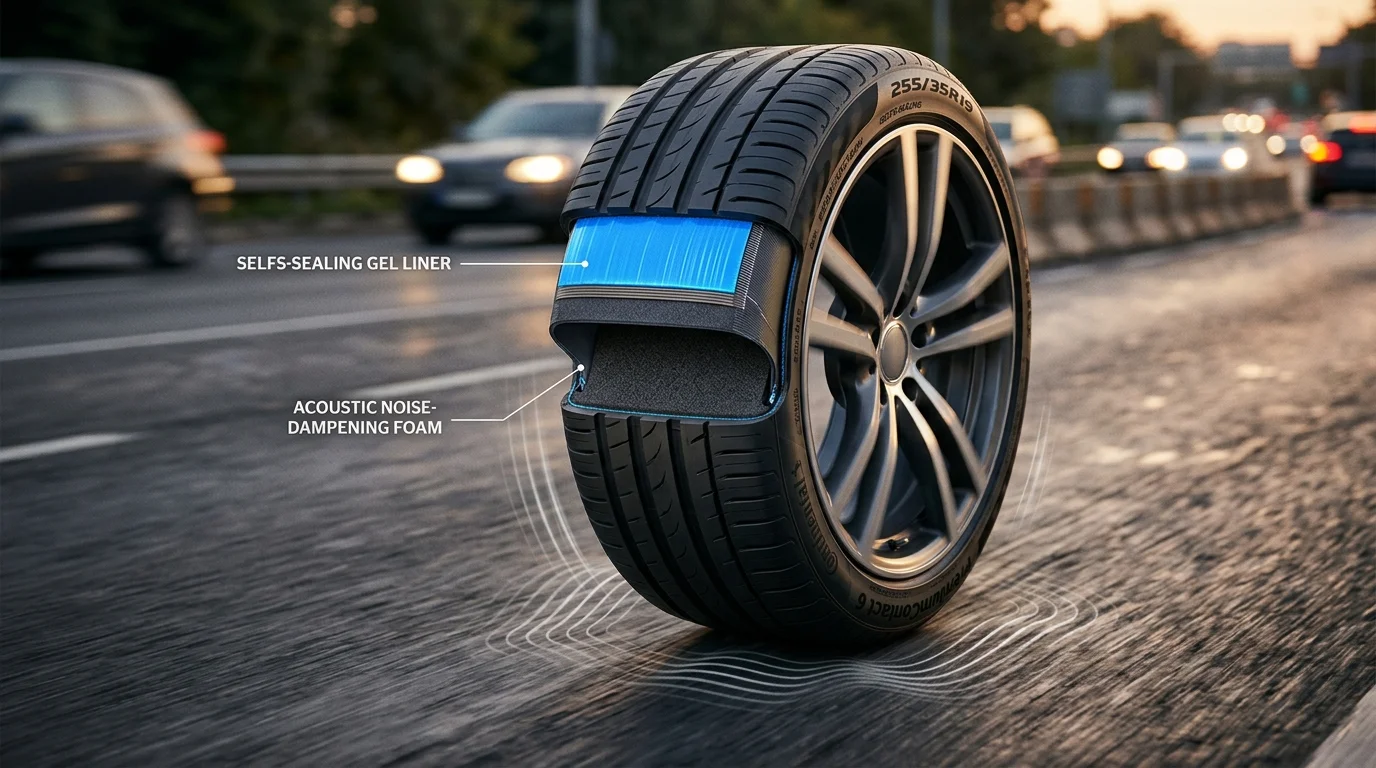
The polyurethane foam pad is bonded against the inner tread wall - the part of the tire that faces the air chamber. It does not contact the rim bead, does not alter the sidewall, and does not change the tire's external profile. The tire's structural cords, sidewall stiffness, and contact patch geometry remain completely unchanged. What the liner does affect is what happens inside the air chamber - and that effect is positive.
Does it hurt fuel economy?
The effect is negligible. The liner adds a small amount of rotational mass, comparable to a minor tyre pressure difference. It does not alter rolling resistance or aerodynamic profile.
Fuel economy is affected by three main factors at the tire: rolling resistance (how the tread deforms under load), aerodynamics (irrelevant here, this is inside the tire), and rotating mass (how much energy it takes to spin the wheel).
The gel liner adds a small amount of mass evenly distributed around the inside of the tread. Because it is distributed uniformly rather than as an unbalanced point mass, the additional rotating inertia is minimal - comparable to running your tires a few PSI below optimal. In day-to-day driving, most people will not notice a difference. For drivers running very high annual mileage on large fleets, the liner's ROI from eliminated flat tires dwarfs any marginal fuel cost.
Does it affect balance or handling?
No steering vibration. Our technicians run every wheel through electronic dynamic balancing after the liner is seated, so zero imbalance leaves the installation.
This is the technical question we take most seriously. Any mass added inside a tire, if not evenly distributed, will create an imbalance that causes steering wheel vibration and uneven tread wear.
The liner is cut precisely to circumference and bonded uniformly against the tread wall, which minimises inherent imbalance from the start. After installation, every wheel is placed on our onboard electronic dynamic balancer. We verify that residual imbalance is within tolerance and apply corrective weights if needed before the wheel is remounted. The vehicle is not returned to the road until spin balance is confirmed. This step is not optional - it is standard in every installation.
The upside you did not expect: a quieter ride
The same foam that seals punctures also absorbs road noise. The cabin runs noticeably quieter after installation - a protection product that improves the driving experience.
Most drivers expect a zero-sum trade. They assume protection comes at a cost to comfort. The gel liner breaks that pattern. Road noise reaches the cabin primarily through three paths: tread contact vibration into the rim, structure-borne resonance through the suspension, and airborne transmission through doors and seals. The foam liner addresses the first path directly.
The thick polyurethane foam layer sits between the tread rubber and the air column. When the tread contacts the road and vibrates, that energy normally resonates through the air column and into the rim. The foam intercepts that energy and converts it to negligible heat, reducing the amplitude of vibration that reaches the wheel and cabin. The result is a noticeably quieter ride at highway speeds - especially on rough provincial roads and concrete surfaces where road noise is most pronounced.
To be clear: this is not unique to our product. Any foam-based acoustic liner will dampen road noise. We mention it because it is a genuine, measurable benefit that surprises most first-time users - and because for Grab drivers and fleet operators spending six to ten hours daily on the road, it is a meaningful quality-of-life improvement worth knowing about before you decide.
Any real trade-offs?
Two honest ones: the liner cannot seal large gashes or sidewall damage, and it adds slight rotational mass. Both are minor compared to eliminating roadside flat tire incidents entirely.
Here are the genuine limitations, stated plainly:
- Puncture size limit. The gel seals nail and screw punctures in the tread area. A large cut, sidewall tear, or blowout is beyond any liner. Those require tire replacement.
- Slight rotational mass added. The foam pad adds a small amount of weight. It is negligible under normal driving conditions, but we state it because you asked and honesty matters to us.
Those are the real trade-offs. Nothing else. For a full breakdown of how the gel mechanism works, read how a self-sealing gel liner keeps you rolling.
Book Your On-Site Installation
Our mobile technicians come to your driveway, fleet depot, or office across Metro Cebu. Every installation includes electronic spin balancing and tyre pressure verification.
Call or WhatsApp +63 927 327 2170