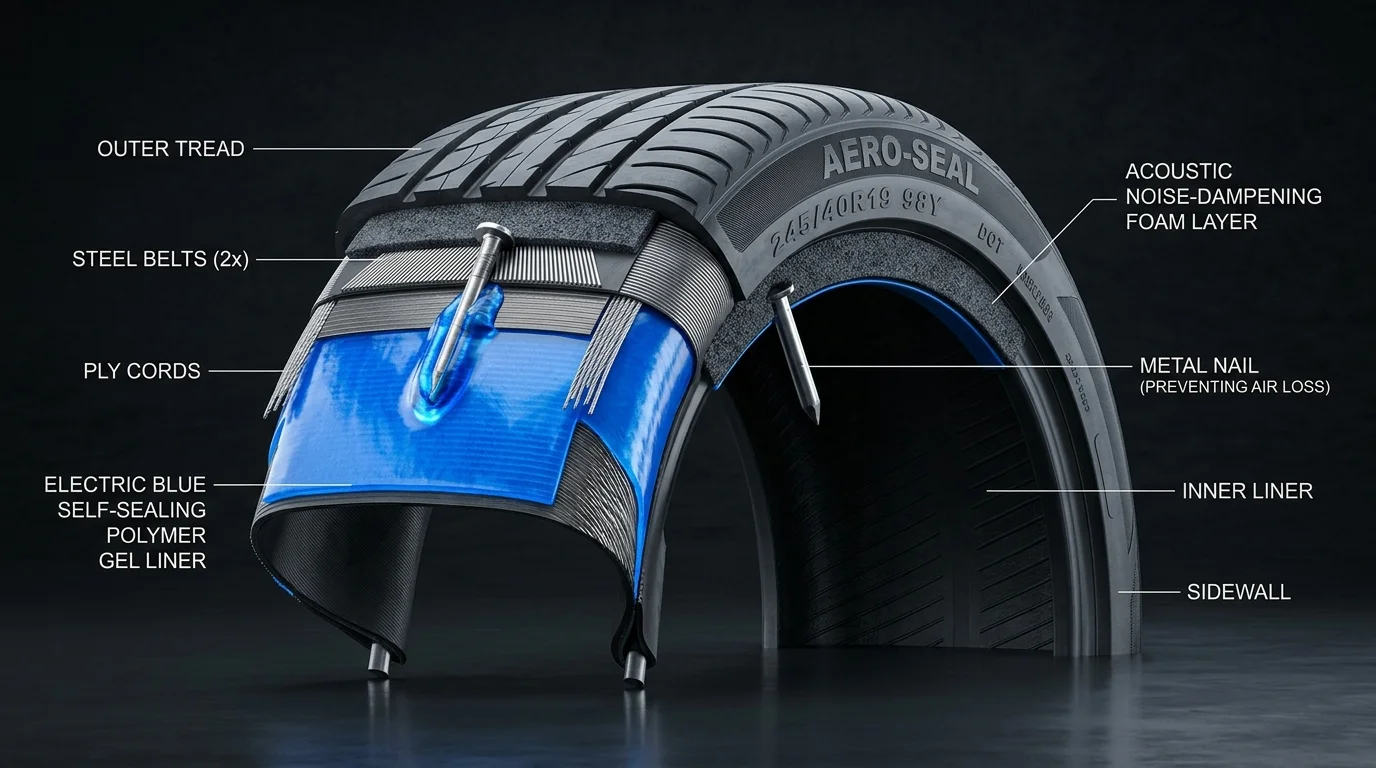
What is a gel tire liner?
A soft gel layer fitted against the inside of your tire's tread. It stays put as you drive and goes to work the moment something sharp gets through.
A gel tire liner is a thick, flexible foam pad with a sticky self-sealing gel compound bonded to one face. That gel-coated face sits flush against the inside of the tire's tread area. The outer foam face faces inward toward the air chamber. The pad is secured in place during installation and remains bonded to the inner tread surface for the life of the tire.
The gel compound is the key component. It behaves like a dense, sticky fluid at rest - sitting dormant against the tread. The moment a sharp object penetrates the tread rubber and touches the gel layer, it triggers the sealing response. No electronics, no inflation systems, no moving parts. The gel does the work passively, every time.
What happens when a nail punctures the tire?
The nail pushes through the tread and into the gel. The gel flows around it and seals the gap, so air stays in instead of rushing out. You keep driving.
Here is what physically happens in sequence. A nail on the road contacts the tire tread. Tire rotation and vehicle weight drive the nail through the outer rubber. The nail tip reaches the gel layer. The gel compound immediately flows into the void created by the nail shaft, surrounding it on all sides under the pressure of the air column above.
While the nail remains lodged in the tire, the gel seal holds. No air escapes around the shaft because the gel has filled every gap. If the nail later works its way out - which happens naturally as the tread flexes through thousands of rotations - the gel collapses inward and closes the hole behind it. The seal is maintained in both cases.
You will typically not feel this event happen. No steering pull. No warning light. The tire continues to hold its full operating pressure. Most drivers discover the nail only during a regular inspection.
Does it stop the nail from getting in?
No - and that is the honest part. A gel liner does not deflect anything. It seals the puncture the nail makes, which is what actually keeps you from going flat.
Some products in this category are marketed with language like "armor," "shield," or "puncture-proof." That framing is misleading. No commercially available tire liner deflects road debris. The physics of a loaded vehicle tire rolling at speed make deflection impossible for a soft liner product.
A self-sealing gel liner does something more useful: it lets the nail in and then seals the damage. That sequence - penetration then sealing - is what keeps your tire holding air. Saying this plainly is the point, because if a product claims deflection, you should be skeptical.
Want to compare all puncture protection types side by side? Read tire puncture protection types compared.
How big a puncture can it seal?
It seals typical nail and screw punctures in the tread area. A large gash, a sidewall tear, or a blowout is beyond what any liner or sealant can fix - those require tire replacement.
The overwhelming majority of road punctures come from nails, screws, and wire fragments - objects that create a narrow channel through the tread. These are exactly what the gel compound is designed to seal. The gel flows into the void, matches the shape of the object, and maintains the seal under the pressure of the air column.
Large gashes from curb impacts, sidewall tears, and catastrophic blowouts involve damage to the structural cords of the tire. No liner, sealant, or other product can repair cord damage. These situations require tire replacement. Being upfront about this limit is part of why the product's other claims are credible.
Why does it also make the ride quieter?
The foam layer dampens the vibration and road noise that normally travels through the tread into the air column and up through the wheel, so the cabin becomes noticeably quieter.
Road noise in a vehicle travels through three paths: tread contact vibration into the rim, airborne transmission through the door seals, and structure-borne vibration through the suspension. The gel liner targets the first path. The thick polyurethane foam pad acts as an acoustic absorber - it converts kinetic vibration energy from the tread contact patch into heat, rather than allowing it to resonate into the air chamber and wheel.
This is the reason the product is sometimes referred to as an acoustic liner. The noise reduction is a built-in consequence of the foam's physical properties, not a separate feature. Drivers consistently report the cabin feeling quieter at highway speeds after installation, which is a meaningful quality-of-life improvement for those who spend hours per day behind the wheel.
Does it affect fuel, balance, or handling?
No measurable effect on fuel economy or handling. Our technicians perform electronic spin balancing after every installation, so wheel balance is verified before your vehicle leaves.
The foam pad is lightweight and bonded uniformly along the inside circumference of the tire. Because it is distributed evenly, it adds no significant imbalance. The small additional rotational mass is comparable to a minor tire pressure variation. Our mobile technicians run each wheel through electronic dynamic balancing after the liner is seated to confirm zero vibration before the vehicle is returned to the road.
Fuel economy is not affected because the liner is inside the tire and does not alter the tire's rolling resistance, contact patch geometry, or aerodynamic profile. For a more detailed breakdown of ride effects, read our dedicated page on whether tire liners affect ride, fuel, or noise.
Book Mobile Installation in Metro Cebu
Our technicians come to your location - home, office, or fleet depot - anywhere in Cebu City, Mandaue, Lapu-Lapu, or Talisay. Under 25 minutes per wheel.
Questions? Call or WhatsApp +63 927 327 2170