Why do logistics fleets need puncture protection?
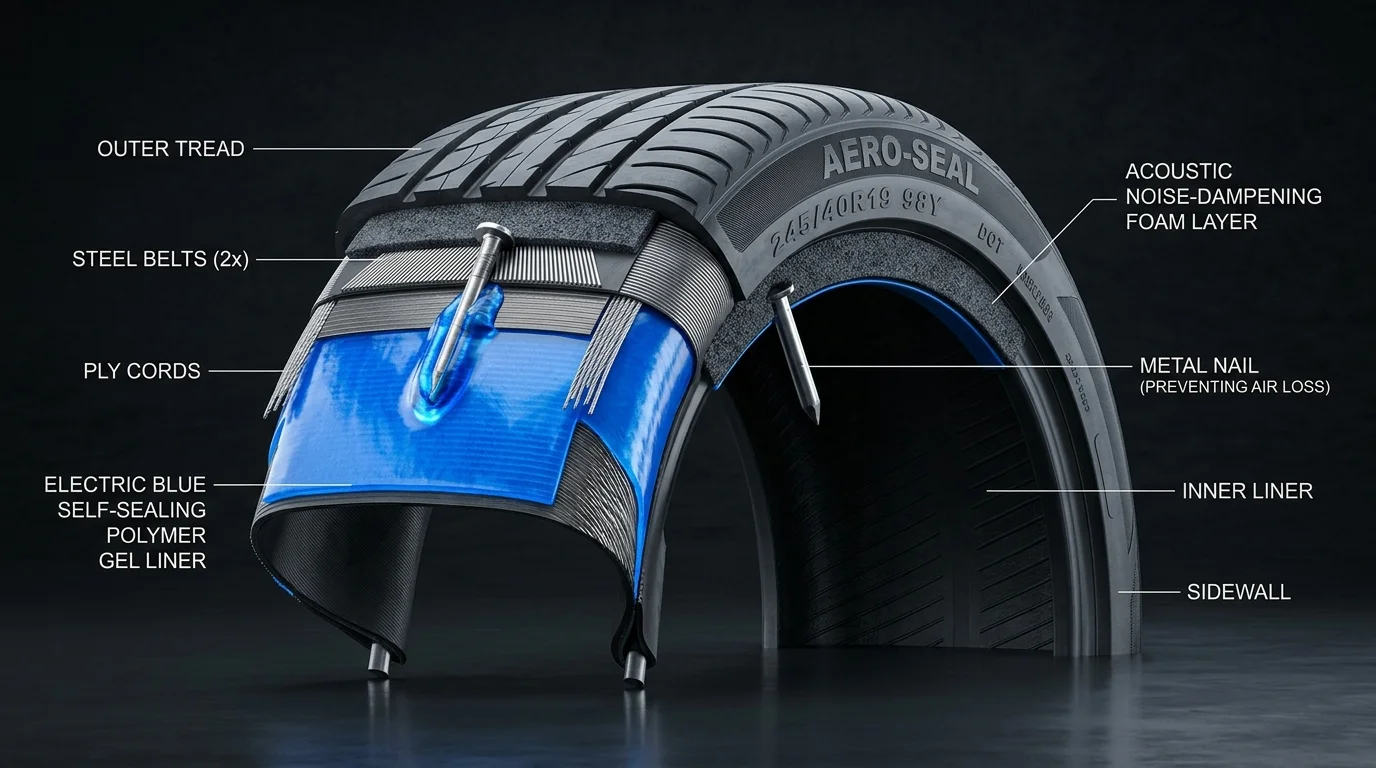
A flat pulls a truck off its route and breaks the delivery chain behind it. Every stop cascades: the next drop waits, the driver sits, the client calls. A gel liner seals punctures so the truck keeps moving.
Logistics operators on the Mandaue-Cebu cargo corridor, port approach roads in Lapu-Lapu, and the inter-city freight routes through Minglanilla and Carcar face some of the highest puncture exposure in the region. Construction debris, metal from warehouse loading bays, and road surface deterioration in industrial zones create a constant hazard for loaded vehicles that cannot simply divert.
The math is simple: a truck carrying ₱200,000 of cargo stopped by a ₱20 nail costs far more than the repair bill. It costs the delivery window, the driver's productive hours, any SLA penalty attached to the consignment, and the relationship trust with the consignee that comes from consistent on-time performance.
How does puncture protection improve delivery reliability, not just tire life?
Preventing one puncture per month per vehicle eliminates the chain reaction: stranded vehicle, driver idle time, rescheduled drop, client contact, possible penalty. That is the value - not just fewer tire replacements.
Fleet managers running inter-city or port logistics in Cebu often track tire incidents per vehicle per quarter. The gel liner's impact shows in that metric first - typically within two to three months of a fleet-wide installation, roadside flat incidents drop significantly. The financial benefit is measurable and defensible to management as a documented reduction in a recurring cost line. For the complete downtime cost breakdown, read the real cost of fleet vehicle downtime in Cebu.
How does on-site installation work without stopping our operation?
We schedule depot visits during overnight or early-morning windows, fit batches of 6 to 10 vehicles in one session, and have each truck balanced and ready for first dispatch. No vehicle leaves the yard for a shop trip.
Your coordinator sets the window; we arrive with commercial-rated mounting equipment and handle everything on-site. Volume pricing decreases as fleet size increases. See the full process at mobile installation across Metro Cebu, and fleet rates at tire liner pricing.
What does fleet-wide installation cost for a logistics operator?
Commercial truck liner sets start from ₱15,000 per vehicle for a standard 6-wheel configuration. Fleet accounts of 5 or more units receive volume pricing - typically 10 to 20 percent below single-unit rates.
₱9,000+
Car / Delivery Van (4-wheel)
₱15,000+
6-Wheel Cargo Truck
Custom
10-Wheeler / Fleet Account
Fleet accounts receive a consolidated invoice, full-fleet documentation, and a dedicated coordinator for scheduling. For mixed fleets - delivery vans, pickups, and cargo trucks on a single account - we quote per configuration and issue a single engagement summary. See the complete rate schedule at tire liner pricing in Cebu.
Does it fit the trucks we run - Fuso, Isuzu, Hino?
Yes. The gel liner fits the full range of commercial truck tire profiles used by Cebu logistics fleets - including Fuso Canter and Fighter, Isuzu ELF and NKR, Hino 300 and 500 series, and Mitsubishi L300 delivery vans.
Common tire sizes across these platforms - 7.50 R16, 8.25 R16, 10.00 R20 for cargo trucks; 195 R14C and LT215/70 R15 for L300 and Hi-Ace vans - are all within specification. Our technician measures the exact tread width during the pre-visit assessment and cuts the liner pad to fit precisely. See the full size guide at gel liner size compatibility.
If a puncture is sealed mid-route, does the driver stop?
No. The gel seals the penetration as it happens. The driver keeps moving. At the next scheduled stop, the technician or your depot team inspects the sealed hole. The tire remains in service - the nail is removed and the hole self-seals permanently.
How long does a 10-vehicle depot session take?
Approximately 5 to 7 hours for a 10-vehicle fleet with mixed configurations. Two-axle delivery vans take roughly 45 minutes each; a 6-wheel cargo truck takes 60 to 75 minutes including balancing. We schedule overnight windows so the full fleet is ready for morning dispatch.
For a full technical breakdown of what the liner does during a puncture, read how gel tire liners work. For truck-specific protection detail, see truck and bus tire puncture protection in Cebu.
Protect Every Delivery Route. Start with Your Fleet.
No truck off route. Overnight depot fitting. Volume rates from 5 units. Full documentation for fleet management records.