What are the main types of tire puncture protection?
There are five: self-sealing gel liners, liquid sealant, foam inserts, rigid strip liners, and puncture-resistant tires. They fall into two families - those that seal a puncture, and those that physically block or support the tire.
The right choice depends on what you are protecting, your budget, and whether you are adding protection to existing tires or replacing them. Each type has a genuine use case. This guide covers all five accurately so you can make an informed decision rather than relying on marketing language from any single brand.
At a Glance: All Five Types
| Type | How it works | Permanent? | Quieter ride? | Existing tires? | Main drawback |
|---|---|---|---|---|---|
| Gel liner (ours) | Seals around the puncture | ✓ Yes | ✓ Yes | ✓ Yes | Size limit on puncture seal |
| Liquid sealant | Seals around the puncture | ✗ No | ✗ No | ✓ Yes | Dries out, must reapply; can unbalance |
| Foam insert | Fills/supports tire interior | ✓ Yes | ✓ Some | ✓ Yes | Heavy, higher fuel use, harder to fit |
| Rigid strip | Physical barrier blocks debris | ✓ Yes | ✗ No | ✓ Yes | Doesn't seal - a breakthrough still flats |
| Run-flat tire | Built-in reinforced sidewall | ✓ Yes | ✗ No | ✗ Must replace | Requires full tire replacement |
How does a self-sealing gel liner work?
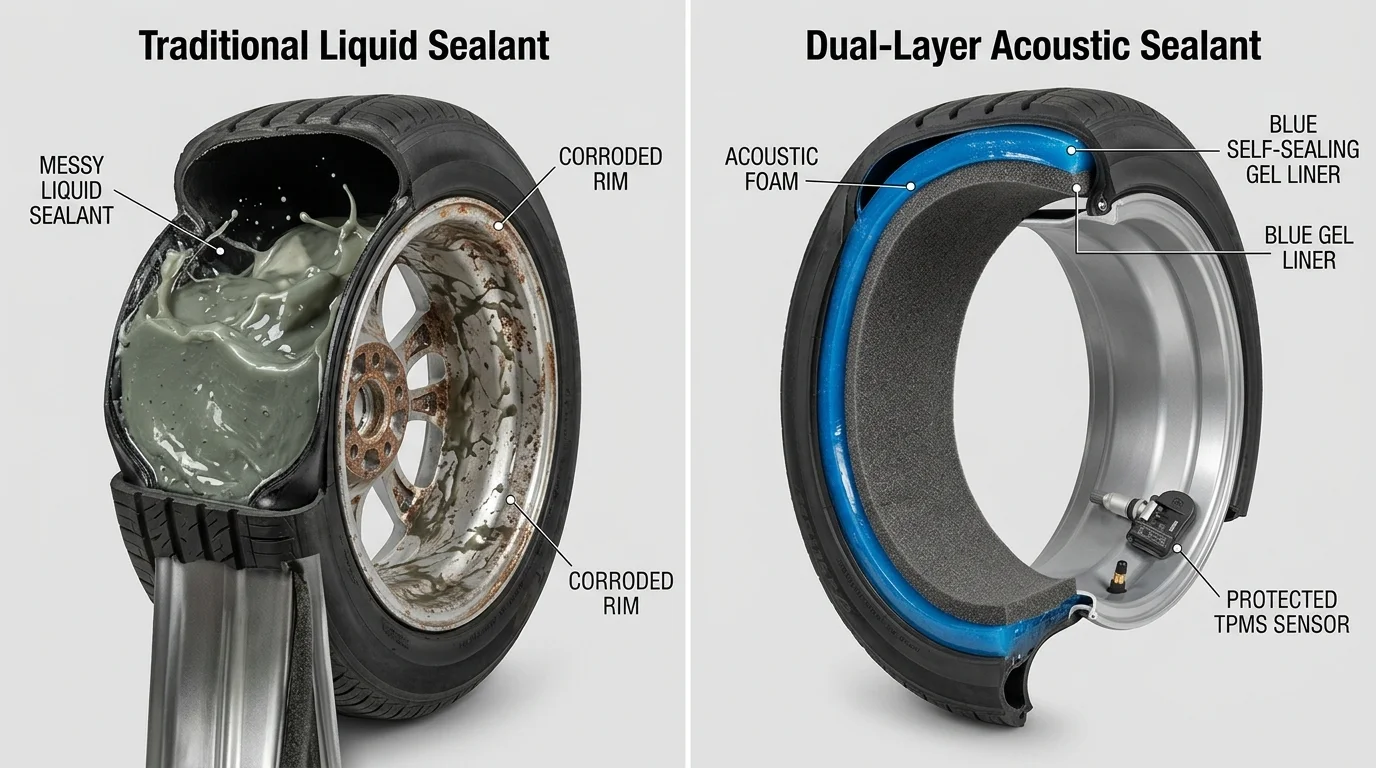
A soft gel layer sits against the inner tread. When a nail penetrates, the gel flows around it and seals the gap so the tire keeps holding air. It also absorbs road noise through the foam backing.
Pros: Permanent - gel does not dry out or require reapplication. Works in normal tires without replacing them. Dampens road noise as a built-in bonus. No heavy rolling-resistance penalty.
Cons: Seals tread punctures up to a practical size limit. Large gashes, sidewall cuts, or cord damage are beyond any liner. Requires professional installation for correct seating and balancing.
Best for: Fleets and drivers who want permanent, maintenance-free, quieter puncture protection without replacing their tires. Read the full breakdown: how the gel liner works.
Gel liner vs liquid sealant - what is the difference?
Both self-seal using the same principle. Liquid sealant dries out and must be reapplied periodically, and can unbalance tires or clog TPMS sensors. A gel liner is permanent and cleaner.
It is important to be clear: liquid sealant (brands like Slime, ASLONG, and local equivalents) and the gel liner use the same core mechanism - a fluid or gel compound flows into a puncture and seals it. Liquid sealant is not "fake" or ineffective. The distinction is in durability and maintenance.
Liquid sealant is a true fluid. It can pool at the bottom of the tire when the vehicle is parked, creating a temporary imbalance on the next drive. It can also dry into a residue over time and must be replenished. In tires with TPMS (Tyre Pressure Monitoring System) sensors, some liquid sealants can clog the sensor valve.
The gel liner is a semi-solid compound bonded to a foam pad. It does not flow freely, does not pool, does not dry out, and does not interact with TPMS sensors. Same self-sealing principle - longer-lasting and lower-maintenance result.
Gel liner vs foam inserts and rigid strip liners
Foam inserts and rigid strips work differently - they physically block or support rather than seal. Both add more weight and rolling resistance, and rigid strips provide no noise benefit and do not seal if something gets through.
Foam inserts (mousse/run-flat cores) fill the tire interior with dense foam. They provide exceptional protection against both punctures and rim impacts and will support the vehicle even with zero air pressure. They are the right choice for off-road, military, and mining applications where extreme terrain justifies the added weight, rolling resistance, and higher installation cost. For Metro Cebu road fleets on paved routes, they are heavier and more expensive than the use case requires.
Rigid strip liners are the product category most often marketed with "armor," "shield," or "barrier" language. A hard PVC, TPU, or polyurethane strip is placed between the tread and the tube. It physically blocks common road debris from reaching the inner tube. The important distinction: a rigid liner does not seal. If a sharp object is long enough or sharp enough to penetrate through the strip, it causes a normal puncture with no sealing response. There is also no noise benefit, because the strip is rigid rather than acoustically absorbent.
A gel liner is lighter, quieter, and seals around objects that penetrate - rather than trying to physically stop them.
What about puncture-resistant or run-flat tires?
These build protection into the tire itself, but require replacing your existing tires - a significantly higher cost than adding a liner. Run-flat tires also cannot always be repaired after a puncture.
Puncture-resistant tires (with Kevlar or aramid layers) and run-flat tires (with reinforced sidewalls) embed protection directly into the tire structure. They are effective solutions if you are in the market for new tires regardless.
The key limitation for most fleet operators and drivers in Cebu: they require full tire replacement. If you have recently purchased tires, or if your existing tires still have usable tread life, replacing them entirely to gain puncture resistance is a far larger spend than adding a liner to what you already have. See what tire liner installation costs compared: pricing for Metro Cebu.
Which type is best for a fleet or daily driver in Cebu?
For protecting existing tires with permanent, low-maintenance, quieter coverage installed on-site, a gel liner fits most Metro Cebu fleets and daily drivers. It is the only option available as a local on-site mobile service.
The correct answer depends on your use case. For extreme off-road, mining, or military use, a foam insert may justify the weight. If you are buying new tires and want integrated protection, a puncture-resistant tire makes sense. If you only have a bicycle or light motorbike, liquid sealant is a practical low-cost option.
For Metro Cebu logistics fleets, delivery vans, Grab cars, and private vehicles with existing tires that need protecting without replacement: a gel liner is the practical match. It is permanent, does not require reapplication, dampens road noise, works in normal tires, and is available as a local mobile on-site service across Cebu City, Mandaue, Lapu-Lapu, and Talisay. Read more about fleet tire protection in Cebu or see how on-site installation works.
Get a Gel Liner Installed in Metro Cebu
Our mobile technicians come to your driveway, depot, or office anywhere in Metro Cebu. Under 25 minutes per wheel. Electronic balancing included.
Call or WhatsApp +63 927 327 2170