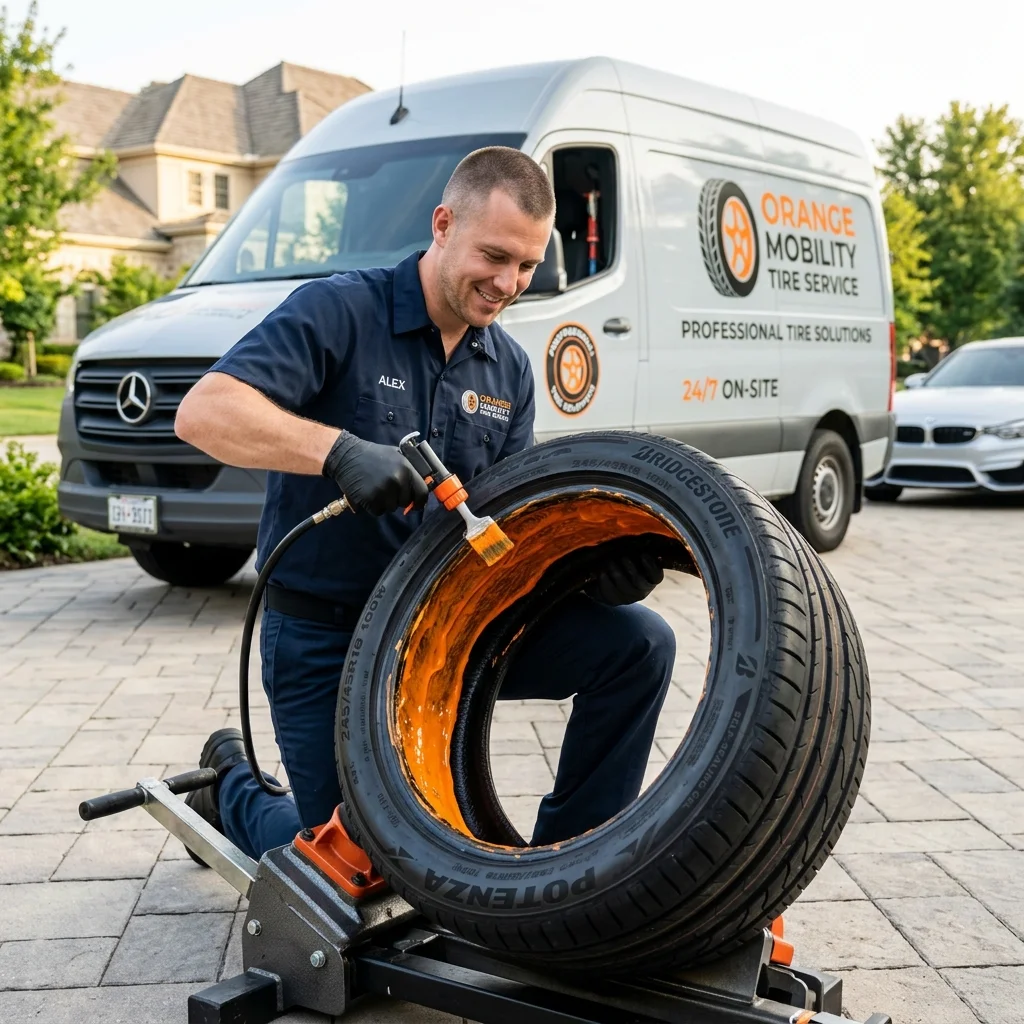
Why do most EVs in Cebu come without a spare tyre?
EV manufacturers remove the spare to save weight and free up underfloor space for battery packs. The BYD Atto 3, BYD Dolphin, BYD Seal, MG ZS EV, and Geely Coolray EV all ship to the Philippines with no spare — only a tyre repair kit or run-flat coating.
The tyre repair kit included with most EVs — a foam sealant canister and a portable inflator — is designed for minor tread punctures on roads where you can stop safely and wait for the foam to set. On Cebu's urban roads, where a puncture typically happens in traffic, on a narrow barangay road, or on an elevated highway with no shoulder, stopping and operating a canister in live traffic is not a practical option.
The deeper problem: if the foam kit fails — if the puncture is too large, or if it is a sidewall failure — the EV owner has no backup. The only option is a tow truck. In Cebu, tow availability is inconsistent, tow times average 45 to 90 minutes, and for an EV, towing introduces an additional risk: many flatbed operators are not familiar with EV tow points, and incorrect hookup can damage the battery chassis. A gel liner does not eliminate all these risks, but it eliminates the category of event that causes them: the tread puncture.
Do EVs get more punctures than petrol cars?
Yes, proportionally. EVs are 15 to 30 percent heavier than equivalent petrol cars due to battery packs. Greater weight increases tyre contact pressure, accelerates tread wear, and forces more debris deeper into the tread on impact — making tread punctures more frequent and faster to deflate.
A BYD Atto 3 weighs approximately 1,750 kg — around 300 kg heavier than a Toyota Vios. That extra mass sits on four contact patches the same size as a petrol car. On roads with loose aggregate, metal construction debris, and the nail hazard common to Mandaue industrial zones and Lapu-Lapu development corridors, a heavier tyre contact patch punches debris through the tread more reliably than a lighter one.
+25%
Average EV weight penalty vs equivalent petrol car
0
Spares in BYD Atto 3, Dolphin, Seal, MG ZS EV
45–90min
Average Cebu tow truck wait for an EV flat
Instant torque delivery — the defining characteristic of EV acceleration — also increases lateral tyre stress during hard starts. While this primarily affects tread wear rather than puncture rate, it is a compounding factor that makes tyre health more critical in an EV than in a petrol car.
Does the gel liner work on my specific EV model?
Yes. Gel liners are compatible with all EV models currently sold in Cebu. The liner fits inside the tyre — it does not touch the wheel, the TPMS sensor, or any electronic component. Your tyre pressure monitoring system continues to function normally.
| EV Model | Spare Included? | Common Tyre Size | Liner Compatible |
|---|---|---|---|
| BYD Atto 3 | No | 235/50 R18 | ✓ Yes |
| BYD Dolphin | No | 195/60 R16 | ✓ Yes |
| BYD Seal | No | 235/45 R18 | ✓ Yes |
| MG ZS EV | No | 215/55 R17 | ✓ Yes |
| Geely Coolray EV | No | 215/55 R17 | ✓ Yes |
| Nissan Leaf | Kit only | 205/55 R16 | ✓ Yes |
| Wuling Air EV | No | 165/60 R14 | ✓ Yes |
TPMS sensors remain fully functional after installation. The liner does not affect sensor readings, tyre pressure, or ADAS calibration. Confirm your exact tyre size at the full size compatibility guide.
Will the gel liner trigger my EV's TPMS or void my warranty?
No. The gel liner is a passive, mechanical product — it contains no electronics and produces no signal. TPMS sensors read tyre pressure from within the wheel cavity; the liner sits in the tread band and does not contact the sensor, the valve stem, or any electronic component.
Does it void my BYD or MG warranty?
Tyres are a consumable and are typically excluded from EV powertrain warranties. A tyre liner fitted inside the tyre — with no modification to the wheel or vehicle — is in the same category as tyre pressure regulators or wheel balancing weights. We recommend confirming with your dealer if you have a specific warranty concern.
Can you install at my home charger location?
Yes. We bring all equipment to your home, condo parking, or any location where your EV is parked and plugged in. Installation takes approximately 90 minutes for a 4-wheel set. You can charge and install simultaneously — no need to move the car to a shop.
If a nail is sealed mid-drive, do I stop immediately?
No. The gel seals the puncture as the nail enters the tread. Pressure holds and handling is unaffected for tread punctures. Continue to your destination and inspect at your next stop. The nail is removed and the self-sealed hole is confirmed — tyre remains in service.
Does the liner affect range or rolling resistance?
The effect is minimal. The liner adds 100–200g per tyre — comparable to a balancing weight. Some EV owners report a very slight range reduction (<1%) in real-world testing. The tradeoff against the cost of a tow plus lost range from a full flat is clear. Read the full analysis at ride, fuel, and noise effects.
What does EV gel liner installation cost in Cebu?
EV installation is priced on the same schedule as equivalent car and SUV sets. Most Cebu EVs use 16″ to 18″ tyre sizes — a 4-wheel set starts from ₱9,000. Larger SUV-profile EVs (18″) start from ₱11,000. We come to you — no shop trip, no towing, no downtime.
Compact EV
₱9,000+
Dolphin, Air EV (16″)
SUV EV
₱11,000+
Atto 3, Seal, ZS EV (17–18″)
EV Fleet (3+)
Volume
Discounted per-unit rate
Compare against the cost of one tow call in Cebu (₱1,500–₱3,000) plus lost charging time plus the inconvenience of a 90-minute wait. Full pricing details at tire liner pricing in Cebu.
Your EV Has No Spare. Now It Has Something Better.
We come to your home, condo, or office. Install while you charge. Under 90 minutes. Drive protected the same day.